
Technical Heritage
Štrekna is not only a modern, scenic cycling route but also a rich treasury of technical heritage, serving as a timeless monument to human ingenuity and determination in overcoming challenging natural terrain. The renovated former infrastructure along Štrekna includes numerous tunnels, bridges, viaducts, and other constructions, allowing today’s travelers to explore by bicycle the picturesque natural beauty and technical legacy of the Koroška and Šaleška Valley regions.


Railway Line Velenje – Dravograd
Construction of the railway section from Velenje to Dravograd began in 1897 and it was officially opened on December 20, 1899. More than 2,200 workers took part in the construction, during which they had to dig 5 tunnels and build 8 bridges over the Paka River between Velenje and Mislinja, as well as construct a viaduct near Gornji Dolič. Additionally, they had to overcome an elevation gain of 204 meters. The construction of the Velenje – Dravograd railway line was a significant infrastructural achievement, officially commemorated with a special leaflet upon its opening.
Tunnels through the Huda Luknja Gorge
Due to the winding valley of the Paka River, which has carved a narrow, sometimes canyon-like gorge into the eastern extensions of Karavanke, it was necessary to build five tunnels: Paka 1, Paka 2, Huda Luknja, Gornji Dolič, and Mislinja. The longest tunnel is Huda Luknja, measuring 421 meters, while the total length of all tunnels reaches an impressive 856 meters! After the railway line was closed, the Paka 1 tunnel was even used for mushroom cultivation for some time. The renovated Gornji Dolič and Mislinja tunnels are now part of the Štrekna cycling path. A true feast for the eyes is the stone arch bridge over the Ponikva stream, which flows from the Huda Luknja cave near the tunnel of the same name. It is one of the most picturesque and also one of the most demanding engineering structures on the railway line.



Bridges and Viaducts
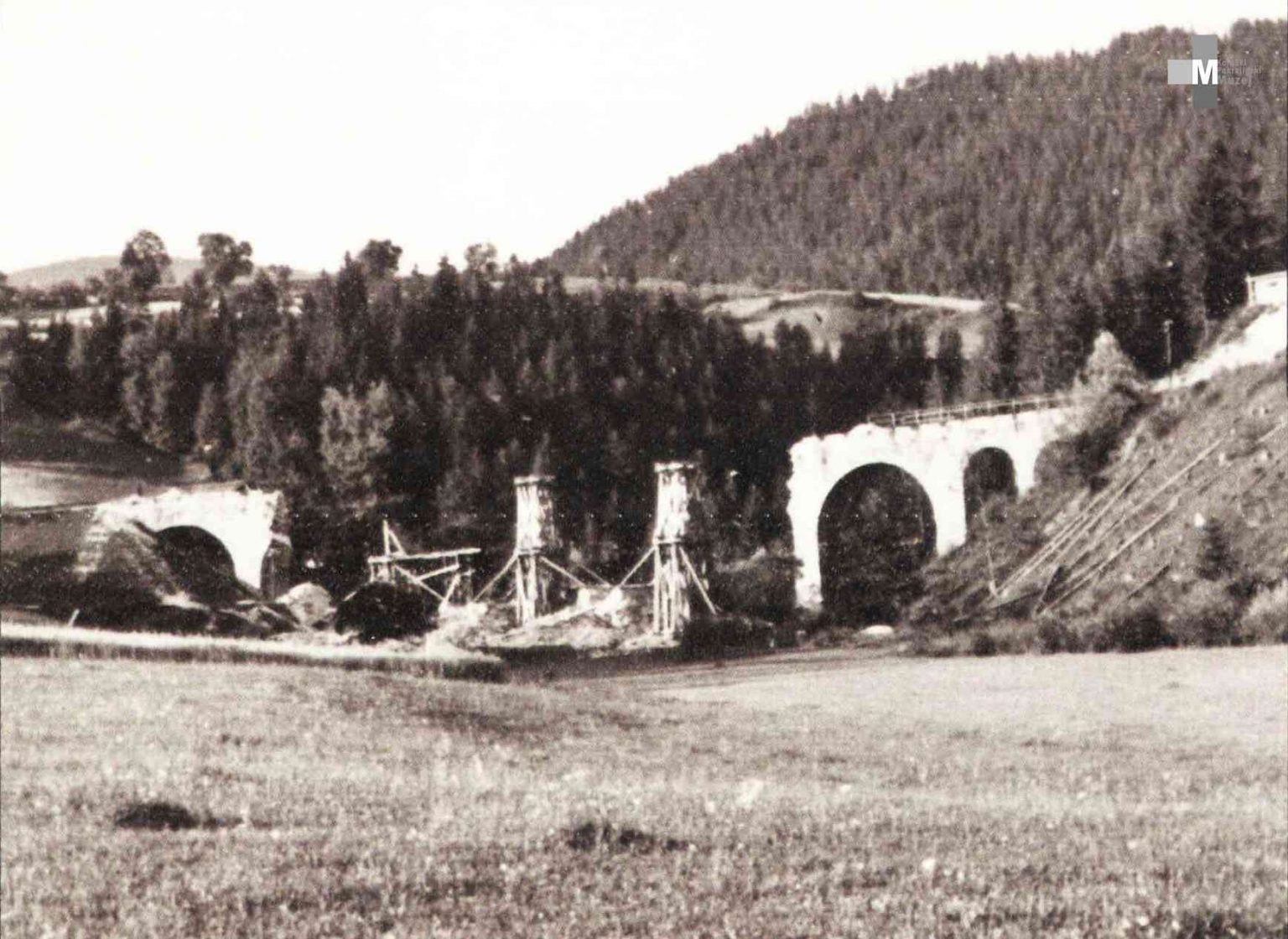
Where rocks did not obstruct the gorge, it was necessary to cross the torrential stream eight times. Of the 8 bridges, 7 had steel constructions, with the longest spanning a gap of 29.7 meters. Near the Gornji Dolič station, the railway last crossed the Paka River via a 14.6-meter-long stone arch bridge. The most famous engineering structure is the Gornji Dolič viaduct, which is over 100 meters long and consists of eight arches. It also has a rich history, having survived demolition during the war.
Partisan units carried out 80 sabotage actions on the railway line between Celje and Dravograd from April to November 1944. On the night of June 18, 1944, the Zidanšek Brigade destroyed four arches of the railway viaduct in Gornji Dolič. The aim was to prevent the Germans from transporting lignite from the Velenje coal mine. The viaduct was quickly repaired.
Shortly after Slovenj Gradec, the railway crossed a 32-meter-long steel bridge, which has been beautifully restored and now serves cyclists and pedestrians. The last time a locomotive crossed the Mislinja River was over a 42-meter-long bridge near Otiški Vrh.
Water Towers
Have you ever wondered what these structures along the railway were used for? All stations needed large quantities of “soft” water to supply the steam locomotives, which was usually stored in special buildings called water towers. Water towers stored water at such a height that it could easily and quickly flow by gravity through pipes into the locomotives’ tanks (tenders). Supplying water was quite a challenge during busy traffic, so the reservoirs were quite large — ranging from 20 to even 70 cubic meters.
This was also a valuable water reserve in case of fires. In 1945, steam locomotives were filled with 20,000 cubic meters of water. The railway, through its investments, indirectly made a significant contribution to the development of local water supply infrastructure.




Railway Stations
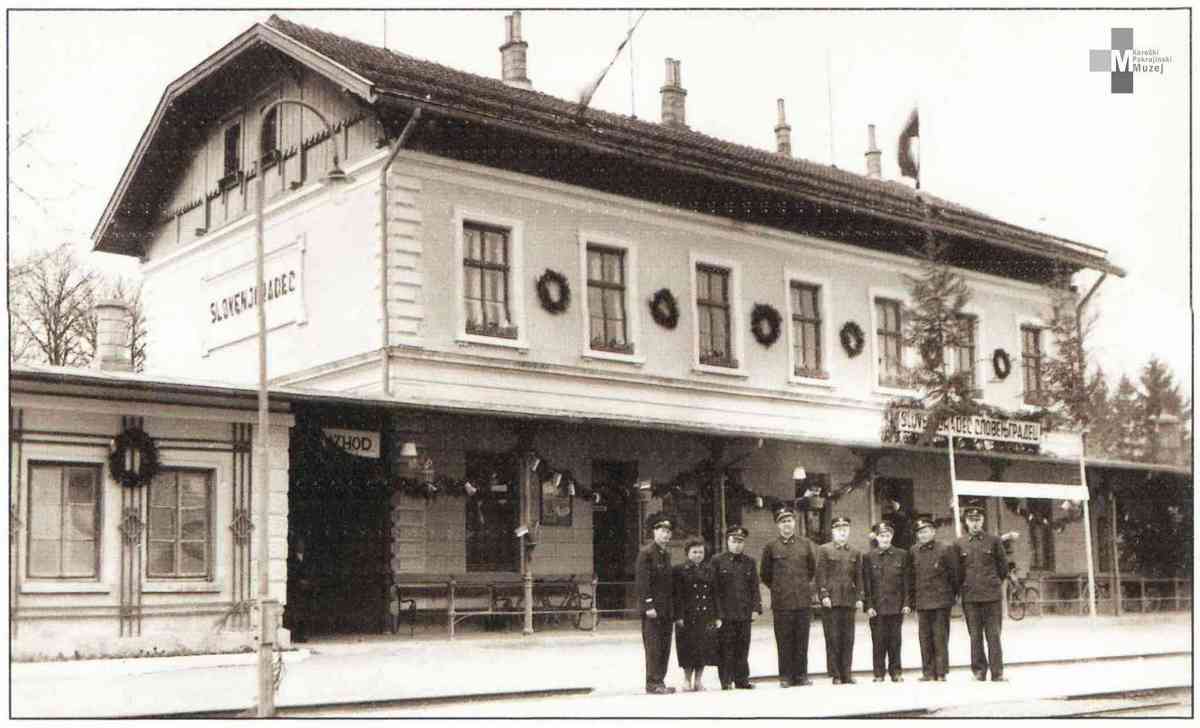
At one time, the railway was the only transport artery in this area, so the stations were essentially windows to the world and the center of activity — places for goods exchange, events, and the most important source of information brought daily by the train. The buildings were designed to accommodate various functions and also to provide lodging for railway staff, which included the stationmaster, dispatchers, signalmen, warehouse workers, lighthouse keepers, stokers, and others.
Many local residents first encountered the telephone here, as the stations had well-developed telecommunications networks. At different times, there were 7 stations and 8 stops operating between Velenje and Dravograd.
Locomotives
Despite their simple operating principle, locomotives were complex machines that only those with many years of experience could operate. A driver became a qualified engineer only after several years of hard work as a stoker, since it was necessary to have a detailed understanding of both the machinery and the route to ensure enough power was maintained on challenging sections. The steel firebox started to be fired several hours before the journey to heat about 5 cubic meters of water to over 250 °C.
Did you know that stokers manually shoveled several tons of coal into the firebox for a single trip? Due to the difficulty of the route, weaker and lighter locomotives ran on the Mislinja railway line, which could reach speeds of over 60 km/h. The journey between Velenje and Dravograd typically took 1 hour and 45 minutes, while a mixed train took just over 3 hours.


Life Along the Railway
It’s no surprise that the memories of older residents of our region about their first school trip, first journey to the seaside, and other experiences often begin right at the railway station. After the war, the train was the primary means of transport for both people and goods. Trains were even given names based on their direction, such as the “Mariborčan,” and they also served as a way to mark time. If the first train woke you up, it was already time to get up. People especially looked forward to the “half-past twelve train,” which meant lunchtime, and the “seventh train,” signaling that work in the fields was coming to an end.
Children’s Mischief by the Railway
Locomotives, those big moving machines, were very fascinating to children, who often played near the tracks and stations, paying close attention to the shaking of the rails or “tracks” when a train was approaching. After school, and especially during holidays, they would gather forest fruits in the nearby woods and sell them in the evening near the station. The older kids commuted to school in Velenje, and the more daring boys showed off to their crushes with daring jumps from wagons while the train was moving slowly—of course, this was strictly forbidden!
Nowadays, a very special event brings smiles to children’s faces. Every December, Slovenske Železnice (Slovenian Railways) organize a unique experience for kids—a ride on a genuine, over 100-year-old museum locomotive that travels between Maribor and Dravograd. And on this festive ride, the good men (Santa figures) are never missing.


Closure of the Railway Line
With the rapid development of road traffic, passenger and freight rail transport increasingly shifted to roads. The railway line became unprofitable, and there were no funds for renovation and upgrades. Therefore, passenger service was first discontinued on July 1, 1968, followed by freight service on April 30, 1969. People had grown attached to the train, so the closure was met with great reluctance. Protests erupted, and in Šmartno pri Slovenj Gradcu, weapons were even proposed - in despair. However, market logic favored cars and the more expensive but significantly faster buses, tearing the train out of people’s daily lives.
Between 2007 and 2013, municipalities in the Mislinjska Valley established the Štrekna cycling path along the abandoned railway route, alongside which the Štrekna bus now operates.
Partners
In 2025, the Štrekna Bus service is being upgraded as part of a pilot activity within the TRANS-BORDERS+ project, which is part of the Interreg Central Europe program. Based on challenges identified in previous years, the project platform offers an opportunity for enhancement in line with modern standards and a more suitable scope of operation. With more operating days and an improved bicycle transport system, this popular cross-border service will be able to offer a better (cross-border) user experience, meet increased demand, and respond to the new reality of the Štrekna cycling route and the region, which annually attracts over 100,000 cyclists.
The upgrade is the result of strong cooperation among numerous stakeholders: RRA Koroška, VKG (AT), AKL (AT) as project partners, the Ministry of Environment, Climate and Energy, the Ministry of Infrastructure, the Municipality of Dravograd, the Municipality of Mislinja, the City Municipality of Slovenj Gradec, and the City Municipality of Velenje. The transport operator is the company Nomago d.o.o.




In the expanded partnership, we aim to build on the successful story of the original TRANS-BORDERS project and continue efforts to improve cross-border public passenger transport between multimodal hubs in the Slovenia-Austria border area. As part of the planned service upgrades within the Interreg Joint Pilot Project (JPP), new open-source digital information systems developed during the project will also be piloted and tested.
The project brings together partners from two border regions striving for better connectivity of border areas: one linking Germany, the Czech Republic, and Poland; the other connecting Austria, Slovenia, and Italy.